
Natural Science
From weather, plants and animals to the cosmos and ecology, using real photographs and real cases to build the thinking habit of "observe—connect—infer".
The Bookstore
The collection covers four domains—Natural Science, Life Science, Social Science, and Humanities & Arts— and includes classic books from dozens of publishing groups such as National Geographic, DK, Scholastic, Pearson, Cambridge and Penguin, meeting the knowledge needs of young readers across ages 4–18.
Four Domains
According to Gardner's theory of multiple intelligences, human intelligence includes eight kinds: bodily, logical, spatial, intrapersonal, naturalistic, interpersonal, linguistic and musical. The bookshelves are displayed in colour-coded sections by the four domains, so that children first approach by interest and then go deeper by ability.
From weather, plants and animals to the cosmos and ecology, using real photographs and real cases to build the thinking habit of "observe—connect—infer".
The body, health, emotions and growing up, helping children understand themselves through reading, and understand their relationship with others and the world.
Geography, history, cities and rules, using reading to build a global perspective and to give children's expression grounds and evidence.
Stories, poetry, music and painting, nurturing language sense and aesthetics, and protecting a child's long-term love of words.
The four colours are taken from the spot-colour system of the Mouseion brand guide (7406C / 7480C / 279C / 1645C), used to visually distinguish domains and stages.
How to Choose
Think of a Lexile measure as a reading on an outdoor thermometer: just as you can use the temperature to decide which coat to wear, a Lexile measure can be used to judge how difficult a book is relative to a child's reading ability.
When a child's reading level falls within a book's Lexile range, they can finish the book confidently and comfortably— challenged, but not frustrated, and not bored.
Series & Levels
The National Geographic Learning series has its own scientifically graded system. Combining the design logic of the series with the patterns of children's development, we ensure that reading difficulty, knowledge depth and cognitive level advance in step—avoiding both "falling behind" and "not getting enough".
| Age group | Sub-series | Focus |
|---|---|---|
| Ages 3–6 Early childhood |
Read on your own phonics series | High-frequency words + real photographs + word and sentence decoding. While learning to "spell by sound and read by sight", children build connections between natural things and language. |
| Ages 6–9 Lower primary |
Become an expert reader series | 18 foundational topics across earth science, life science and physical science, forming a knowledge-transfer pathway across 3 difficulty levels. |
| Explore on your own reader series | Forms a "knowledge complement—practice extension" pairing with "Become an expert", supporting project-based reading activities in multiple settings. | |
| World Windows reader series | A cross-disciplinary view of science and social studies: matter and the senses, force and motion, plants and animals, climate, and more, strengthening awareness of text structure. | |
| Ages 10–15 Middle years |
Explorer reader series | Selected classic science articles from National Geographic magazine; each topic is offered at two language levels, Pioneer / Pathfinder. |
| Ladders reading series (lower level) | Matched to different Lexile measures across 3–4 difficulty tiers, with multiple-text reading practice around the same topic. | |
| Ages 16–18 Upper secondary |
Ladders reading series (higher level) | In-depth science topics, strengthening academic vocabulary and understanding of argumentative logic. |
| Footprint series | Each volume covers the cultural footprint of a country / region, across 8 difficulty levels, with science-fiction short-story dramatisation plus scientific report analysis. |
Why choose the National Geographic Learning series? Authoritative and professional, with a complete system; vivid content with strong visual support; precise levelling that fits children's development—from microscopic cells to the macroscopic universe, letting children feel the beauty of nature directly.
Services
Take away not just books, but also "how to read, what to read, and what to talk about after reading".
01
Find the right book at the shelf: recommendations based on the child's interests and language level, and after choosing, sit down and read a passage before deciding.
02
Based on the reading assessment results, we match books within a range from about 50L above the current Lexile to about 100L below, keeping difficulty at a level that is "challenging but not frustrating".
03
Drawing on more than 1,000 titles in the National Geographic Learning series and following the native levelling logic of the series, we precisely match 7 sub-series to the cognitive levels of readers aged 3–18.
04
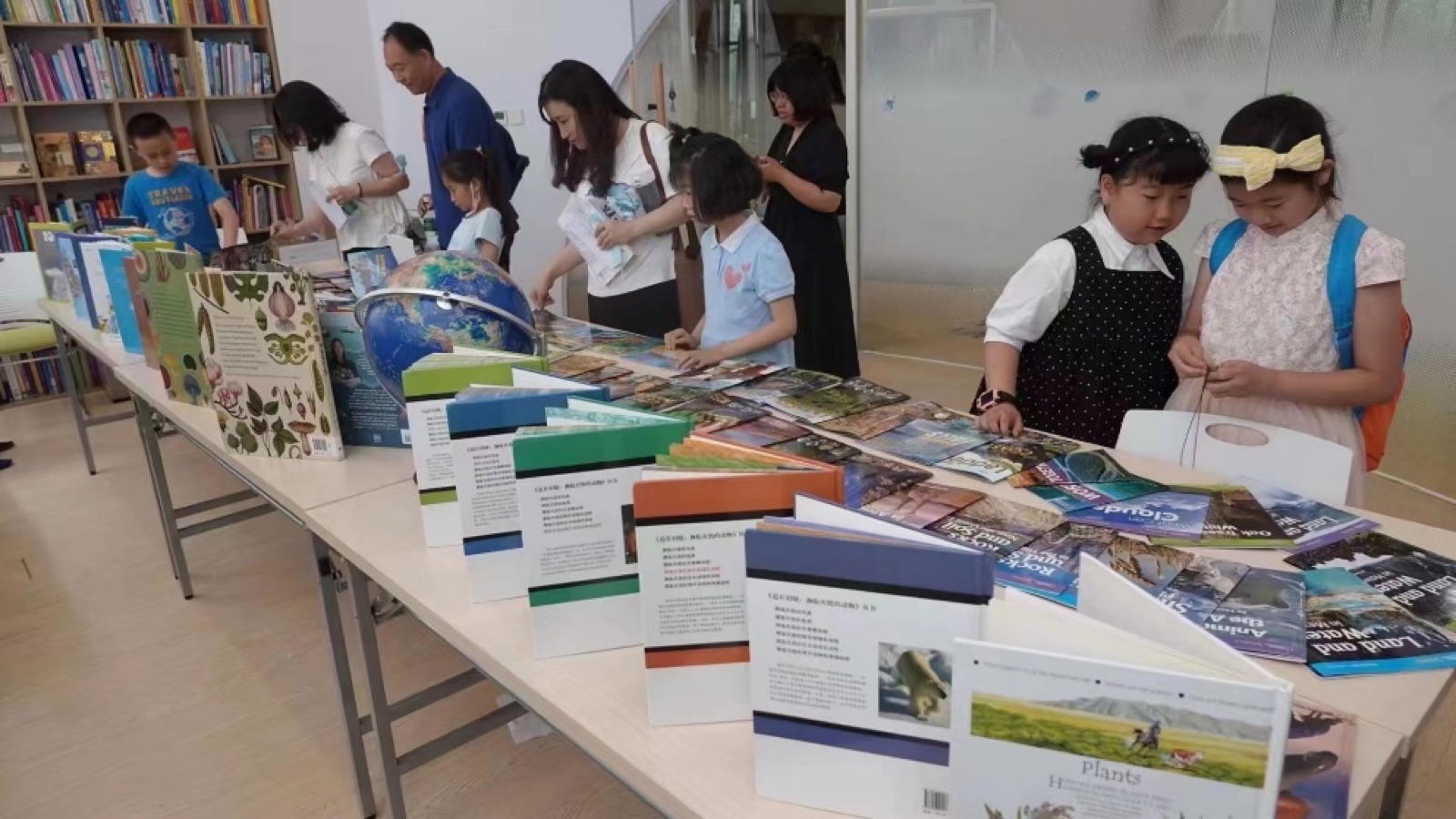
Book fairs themed around World Book Day, Earth Day, World Forest Day, space and science fiction, and more, each focusing on a single theme and coming with a take-away book list.
Mouseion World Travel and Classic English Children's Poems, with 14-day challenge check-ins, give holiday reading its own rhythm; the specific rules for borrowing and in-store reading are subject to store notices and staff guidance.
Highlights
Click any image to view it larger.
FAQ
The ways of borrowing, in-store reading and purchasing books are subject to store notices and staff guidance. Please book your visit in advance, and we will set aside time with a mentor and a seat for your child.
Start with the reading assessment results: we provide a suggested Lexile range, then, combined with the child's areas of interest, pick out 3–5 candidates within the range and let the child read a passage and choose for themselves.
The same topic can be approached from different angles. Referring to the Common Core's recommended ratio of fiction to non-fiction, we start from the stories the child loves and gradually introduce related non-fiction material, rather than replacing their interests from the start.
You can prepare along the lines of a "Holiday Graded Reading Pack": based on the child's Lexile range and reading speed, put together a set of books of increasing difficulty, and leave one or two free choices to "read whenever you like".
Visit
More than 20,000 originals are right there. Don't rush to decide what to read— let your child browse a little, and then we'll choose together.